
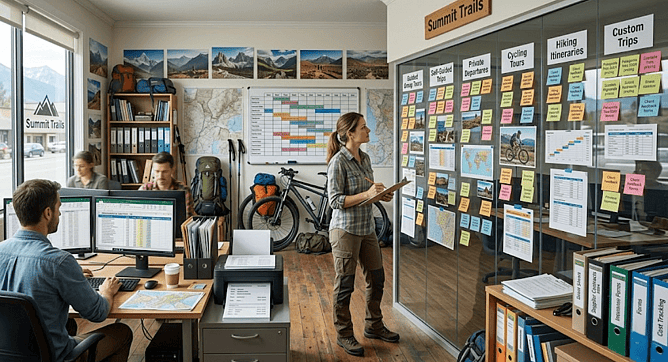
The latest insights from the Adventure Travel Trade Association suggest Operators are leaning towards diversification as a way of building resilience in their business.
Operators are looking for ways to grow (or simply stay profitable), without relying on a single product or market. And this makes complete sense. Initiatives might include moving into new destinations, targeting different types of travellers or marketing different product types. The reality is demand for travel is increasing, and traveller preferences evolve, so diversification is an opportunity to consider.
But before you jump into recreating your tour business there's a few things to consider. Our listening of Operators suggests there's often a gap between the 'let's do something new or different' strategy, and implementation. And it's this 'delivery' phase that often gets overlooked.
© Adventure Travel Trade Association
Diversification is easy in theory, but is harder to deliver
Adding new products isn’t just a business strategy decision. Because of the complexity involved, it also needs to be an operational one.
For example, a guided group trip is very different to a self-guided trip. One is built around guides and logistics, the other is built around customer communication, information and often personal flexibility. Things start to get a little chaotic if a Tour Operator then also adds in private or custom departures, or specialist trips to their product offerings. And if you're entering a new country there might be regulatory and cultural differences to also consider in your delivery practices. And if your branching out into new product types like adding cycling tours to your hiking range then you've got a lot more to think about than just a few bikes.
Each variation brings different workflows, pricing structures, supplier relationships, and customer expectations. And that’s where things start to get more complicated.
Our Tip: Treat every new product idea as both a commercial and operational decision from day one.
More products = more complexity
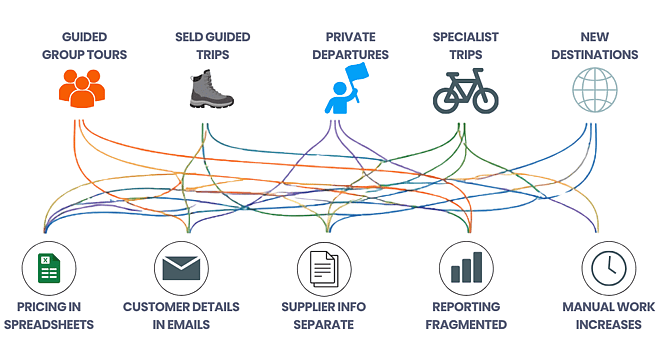
Here's some examples of what diversification often looks like across a Tour Operators systems and workflows:
Pricing and Product details sit across multiple spreadsheets, or documents.
Customer details live in email inboxes or another spreadsheet
Supplier details and costs are tracked separately
Reporting becomes fragmented
So while the business is technically “diversifying”, it’s also becoming harder to manage. And without clear visibility, cost control can end up being more like guesswork.
Steady growth changes the equation
The ATTA data shows most operators are seeing modest growth, not rapid expansion.
This is important because when growth is gradual margins matter more, efficiency matters more and operational discipline matters more. There’s less room to absorb the cost of added complexity.
This is where backing up strategic ideas with connected systems and workflows to enable smooth implementation is really important. Without it, the cost of delivering those ideas might end up outweighing the benefits.
The key question is...
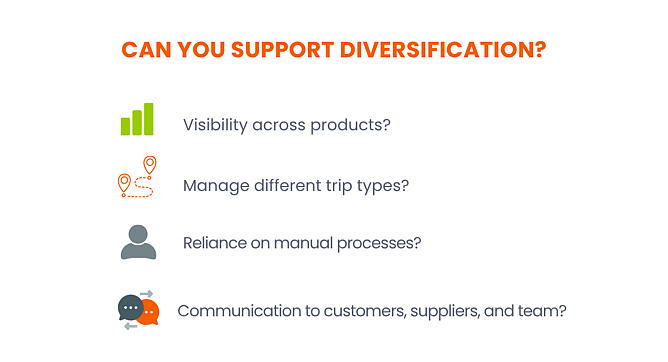
Can you support diversification, without making the business harder to run?
This comes down to:
How clearly can you see performance across products?
How easily can you manage different trip types?
How much manual work sits behind each booking?
What communication tools do you have to reach your customers, suppliers, and guides?
And where are we relying on manual processes today that won’t help us if we add more complexity?
What good looks like
Operators who make diversification work tend to focus on simplifying how the business runs. Examples include...
A single place to co-manage different product types
Clear visibility across bookings, costs, and margins
Structured ways to build and manage itineraries, communicate and manage logistics
Less reliance on disconnected systems... especially spreadsheets
This is not about scaling, this is about being in control. Scaling might naturally occur as a result of being in control.
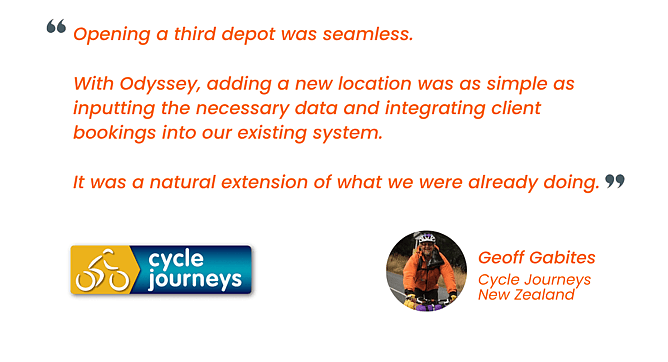
Diversification isn’t just about offering more. It’s about being able to manage more without the business becoming harder to run. Because complexity doesn’t just slow things down. If it's not managed well can also add costs.
This is where Odyssey fits, bringing guided or self-guided, FIT or Group Departure, custom trips, and different products and destinations into one place, so Operators can diversify and grow without making the business harder to run.
About the Author
Al Check is Co-Founder of Odyssey, the operating system for multi-day tour operators. He leads sales, marketing, business development, AI strategy, and channel partnerships, helping tourism businesses simplify operational complexity and build scalable, AI-ready systems.
With more than a decade of experience in adventure tourism, Al has worked across guiding, customer service, reservations, operations, and senior leadership. His hands-on experience includes helping establish a new depot operation for Cycle Journeys and contributing to the leadership of one of New Zealand’s largest self-guided cycling businesses.
Al regularly writes and speaks on tourism operations, business improvement and the role of AI in helping operators turn trusted data into practical business intelligence. He does this through industry communities, including the Adventure Travel Trade Association, Tourpreneur, and Cycle Summit.