
Every multi-day tour operator knows the feeling. The trip is sold. The guests are excited. And now your team has to coordinate with a dozen or more different suppliers, all at once, all expecting different information, all on different timelines.
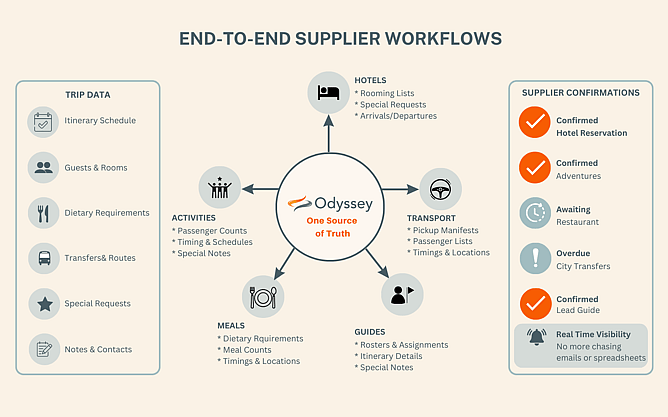
Hotels need rooming lists including the type of room, whose sharing with who, and any ‘special’ requests. Activity providers need passenger counts and timing. Accommodation and meal suppliers need dietary requirements, and transport companies need exact pickup manifests. Most importantly each one of them needs to be confirmed back to you so you can actually tick them off the list.
If you're managing that across email threads, spreadsheets, and your own memory, something will eventually go wrong. Because no person or team can expect to hold all of that together manually.
What makes supplier coordination so difficult for multi-day tour operators?
It mostly comes down to volume and variety.
A single multi-day trip might involve six accommodation providers, three activity companies, two meal stops, and a fleet of transfer vehicles. Each supplier needs a different subset of your trip data at a different point in time. And they all communicate differently. Some respond quickly, while we all know others taken longer. Some need a phone call to confirm what you've already sent them by email.
Your team ends up becoming a bit of a relay station. Information goes from your booking system to a spreadsheet, to an email, to a phone call and back again. Every hand-off is a chance for something to go missing or go wrong. A room count that's out by one. A dietary note that never made it to the restaurant. A driver who shows up at the wrong time because they were working off an old manifest.
These aren't world ending failures on their own. But they do erode trust and confidence with your suppliers, and with your guests.
How do automated supplier confirmations reduce back-and-forth?
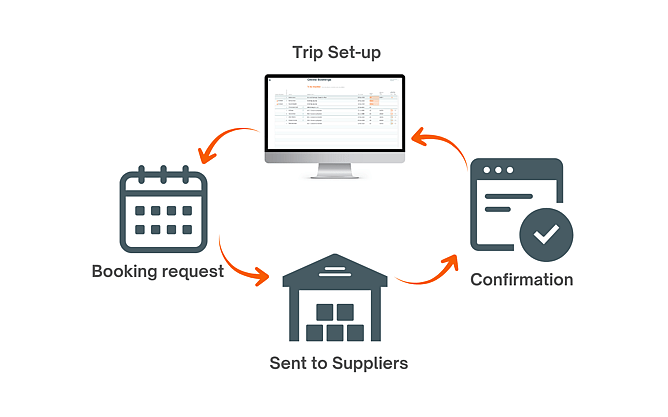
The simplest fix is also the most effective… send every supplier a clear, standardised booking request direct from your tour management system, and track whether they've confirmed it.
In Odyssey, supplier communication works from the same data that runs the rest of your operation. When a trip is set up, the system knows which hotels, activity providers, meal stops, and transport companies are involved. It generates a booking request for each of them, pulling in the exact details they need: tour name, dates and times, guest names, room configurations, dietary requirements, and any special notes.
Your team doesn't type that out manually. It comes from the trip data inside Odyssey.
The Supplier Email Dashboard then shows you the confirmation status of every supplier for every trip. Who has confirmed, who hasn't responded and who you need to follow up. Everything's visible in one place without digging through your emails or asking your colleague if they heard back from the hotel.
Suppliers can also confirm directly through an online form, which updates their status in Odyssey in real time. No email thread needed. No manual updating of a spreadsheet. This is a big efficiency saver.
What happens when an itinerary changes at the last minute?
This is where manual systems can fall apart.
A flight gets delayed, a group size changes or a route gets altered because of weather. If you’re using spreadsheets that change has to be communicated individually to every affected supplier. Your team has to work out who needs to know, draft updated messages for each of them (copy/paste), and hope nothing gets missed.
In Odyssey, a change to the trip data flows through to the relevant supplier communications automatically. Update the itinerary, and the system generates updated outputs for the suppliers who are affected. Rooming lists, transport manifests, activity bookings: all of them reflect the new information.
That doesn't mean every update goes out without anyone reviewing it. Your team still controls what gets sent and when. You can automate these communications or send them manually with a tick of a box to authorise it to go. But the work of pulling together updated documents and figuring out who needs to know is handled by the system, not by a person working through a mental checklist for multiple trips, which is often the case.
How does Odyssey handle accommodation and meal details for suppliers?
Hotel rooming lists and dietary requirements are two of the most common sources of stress in tour operations.
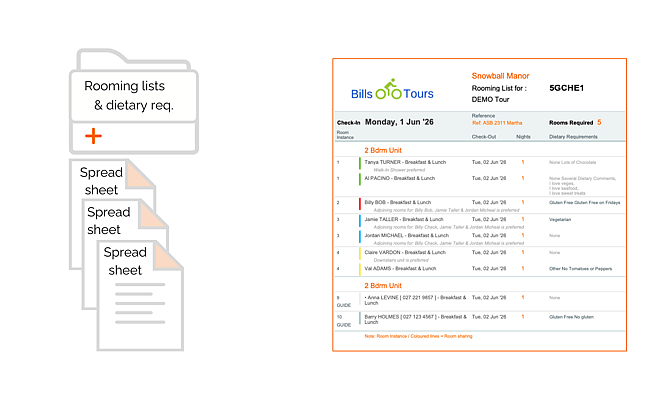
Rooming lists changes might include guests swapping rooms, or couples who booked a twin end up wanting a double. Or someone joins the group late and needs to be added. In Odyssey, room allocations are managed with colour-coded sharing views so your team can see at a glance who is sharing with whom. When a change is made, the rooming list can be regenerated and sent to the hotel without rebuilding it from scratch.
Dietary requirements are handled the same way. Guest preferences come in through online forms and sit directly in the guest's record in Odyssey. When it's time to send the restaurant or caterer their brief, that information is already there. No cross-referencing. No copying from one document to another. The right details go to the right supplier, drawn from the same single source of truth that runs everything else.
How do transport suppliers get the right manifest every time?
Transport is the part of a multi-day tour where precision matters most. A driver who has the wrong pickup location, the wrong passenger list, or the wrong timing can derail the whole day for the group.
Odyssey builds transfer and luggage run manifests directly from your trip data. Exact passenger names, pickup points, times, and any relevant notes. The driver gets a clean, accurate document. Not a version someone typed out from memory and hoped was right.
If the group size changes or a timing shifts, the manifest is regenerated from updated data. The driver always gets the current version, not whatever was sitting in the sent folder from two days ago.
And now you can add your internal or external staff and drivers to Odyssey’s integrated Rostering app. You can push the trip and manifest information directly from Odyssey into an intuitive dashboard for base operational management. And provide a mobile app for your staff and drivers to get full visibility of their schedules ahead.
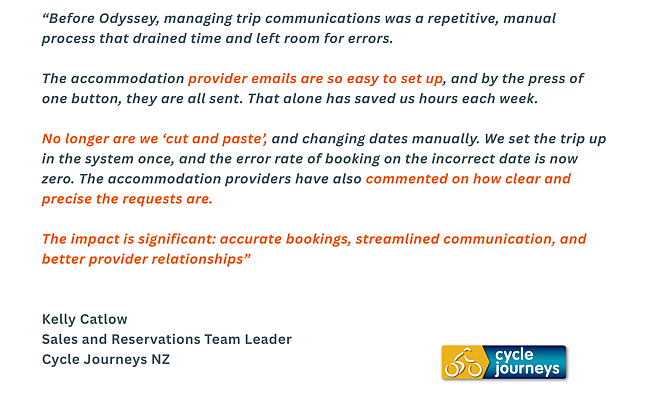
What does a well-run supplier workflow actually look like?
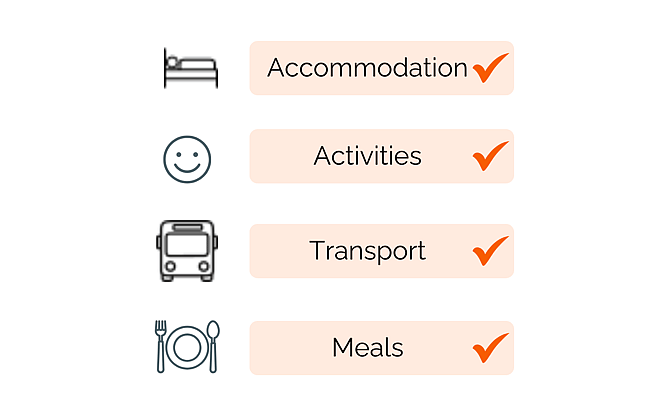
When everything is working properly, your team spends very little time on supplier communication as a task in itself. The system handles the generation of booking requests, rooming lists, dietary briefs, and transport manifests. Your team reviews, approves, and sends. Suppliers confirm, your team tracks the status, and any changes are managed from one place.
What your team gets back is time. Time to focus on the things that actually require human judgement like handling a difficult situation on the ground, building a relationship with a new supplier, or designing the next trip.
And when your suppliers consistently receive clear, accurate, on-time information, they trust you. That matters more than most operators realise. Suppliers who trust you are more responsive, more flexible when things go wrong, and more likely to go the extra mile for your guests.
About the Author
Al Check is Co-Founder of Odyssey, the operating system for multi-day tour operators. He leads sales, marketing, business development, AI strategy, and channel partnerships, helping tourism businesses simplify operational complexity and build scalable, AI-ready systems.
With more than two decades of experience in adventure tourism, Al has worked across guiding, customer service, reservations, operations, and senior leadership. His hands-on experience includes helping establish a new depot operation for Cycle Journeys and contributing to the leadership of one of New Zealand’s largest self-guided cycling businesses.
Al regularly writes and speaks on tourism operations, business improvement and the role of AI in helping operators turn trusted data into practical business intelligence. He does this through industry communities, including the Adventure Travel Trade Association, Tourpreneur, and Cycle Summit.