
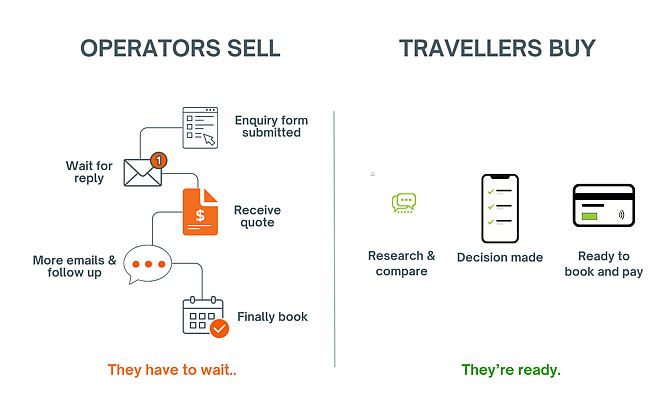
A customer finds your tour, reads through the itinerary, and sends you an enquiry. Then they wait, and you reply with more information and a quote, and maybe some dates. They reply again, asking about deposits. A few days go by and eventually they either commit, or they go quiet.
For a lot of Multi-day Tour Operators this back and forth is still normal. But the way travellers want to buy has moved on, and the gap between how customers expect to purchase and how many Operators still sell might be costing you revenue.
At the same time, something bigger is starting to happen underneath all of this. AI is changing not just how travellers research a trip, but also for how they actually buy as well. We'll touch on that in this blog, but first the buying behaviour that's already changed.
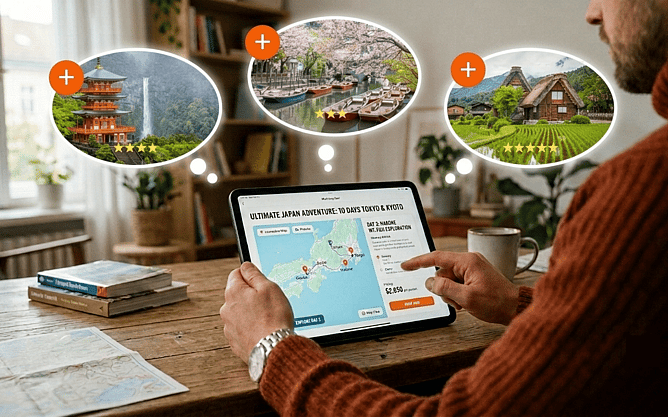
Why are travellers expecting more from the booking process?
Most travellers now do their research online before they ever speak to anyone. They compare options, read your reviews, check what's included, and form a shortlist of options before sending you an enquiry. By the time they do reach out, many of them are ready to commit. They don't want a sales conversation. They want to confirm the details, secure their spot and pay.
An enquiry form asks the customer to do more work to get less certainty. They submit details, wait for a reply, and only then find out if their preferred dates are available, what the actual price is, and what the next step looks like. Every one of those delays is a chance for them to lose momentum, get distracted, or simply book with someone else that allows them to confirm on the spot.
Let’s be clear. This doesn't mean every Multi-day Operator needs a fully automated checkout with zero human contact. It means the customers who are ready to commit should be able to, without having to wait on someone else's reply time. And we’re seeing this more and more in our conversations with operators. Their customers are willing to ‘buy’ high value multi-day tours online.
Why is a Multi-day booking different from a day tour?
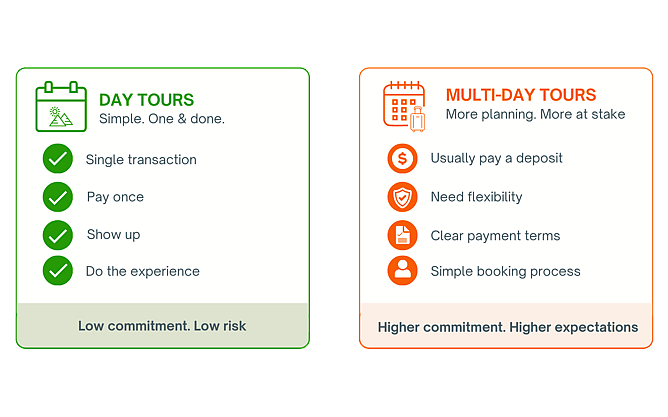
Day tours are usually a simple, single transaction. Pay once, show up, do the experience. Multi-day bookings carry more weight, and customers know this. They're often paying a deposit rather than the full amount upfront. They want reassurance about what happens if their plans change. They want clarity on payment schedules, cancellation terms, and what's actually included before they hand over any money.
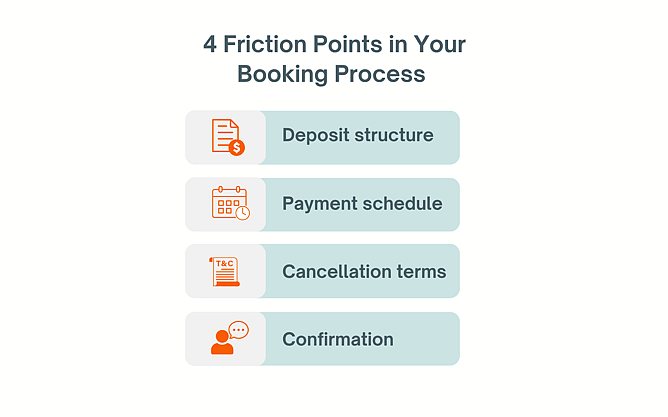
This is where a lot of booking flows fall short. If the deposit structure isn't clear, if the payment schedule isn't visible upfront, or if the customer can't tell what happens next after they pay, hesitation creeps in. And hesitation is where bookings can stall.
The operators who convert well at this stage tend to do a few things consistently. They provide clear departure information, a transparent payment schedule, secure payment handling, and a process that doesn't require the customer to chase anyone for confirmation. None of that is difficult. It just has to be visible and built into the booking flow rather than explained over email afterwards.
Curious what your current booking process is costing you in lost conversions and admin time? Use the Ody Shop booking cost calculator to see how your setup compares to a connected, flat-rate model. https://www.myodyssey.app/calculator/
How is AI changing the way travellers discover and book tours?
This is the part of the conversation that's moving fast. AI tools have stopped being just search assistants. They're starting to act as planning agents, researching destinations, comparing operators, and in some cases shortlisting or completing a booking without the traveller ever visiting a website.
Google, Expedia, OpenAI, and Microsoft already have agentic booking tools live or in active deployment. And here in Aotearoa New Zealand, Tourism New Zealand has just launched it's own itinerary builder which will have book now options very soon.
If your product information isn't structured, current, and Ai readable, these systems may simply skip over you. And it’s not because your tour isn't good, it’s because the AI couldn't find you, understand your offer, or trust the data it found.
Up until now the online booking process has been built for people. A human visits a website, reads the page and compares a few options, and fills in a form. That's starting to change. Now travelers are asking their AI assistant to do that work for them. Something like: "Find me a seven-day self-guided cycling holiday in New Zealand next March for under NZ$4,000." The AI compares the options and can ask clarifying questions if it needs to. And it completes the booking on the traveller's behalf. This is where we are going folks.
Emerging standards, including the Model Context Protocol (MCP) are changing this buying process. MCP is what makes this possible as it gives AI assistants a secure, standardised way to talk directly to booking systems, rather than scraping a website and guessing at what the prices and availability actually mean. This is a significant tech development. The operators who get ready now won't just have a website people can book through. They'll have a booking system that AI can buy from.
What does this mean for a Multi-day Tour Operator right now?
You don't need to overhaul your entire tech stack this week, phew. But it's worth understanding where you are at. If your booking and product data lives in a connected, structured system, you're already in a better position than an operator relying on a static website and a contact form. If your information is scattered across a website, a separate spreadsheet, and someone's inbox then it’s probably time to address this as AI is only going to become more relevant.
The same principle that applies to human buyers applies to AI buyers… any type of friction could lead to a lost sale. For your customer, friction might look like a slow reply or an unclear payment schedule. For an AI assistant, friction looks like product data it can't understand or a booking system it can't connect to. Either way, the result is the same, the booking goes elsewhere.
This is part of why Odyssey was built the way it is. Ody Shop, Odyssey's online sales platform, keeps your booking and product data structured and connected to the rest of your operation from day one. That matters for the human travellers booking today, and it matters for the AI assistants that will increasingly be doing some of that searching and comparing on their behalf.
Given Traveller buying behaviour is shifting to needing a smoother, frictionless buying experience then you should consider reviewing your existing Res Tech booking system.
We've built a calculator to allow you to do this and compare it against a different model like Odyssey.
See what your current booking technology is actually costing you, and how a connected, flat-rate model compares. https://www.myodyssey.app/calculator/
About the Author
Al Check is Co-Founder of Odyssey, the operating system for multi-day tour operators. He leads sales, marketing, business development, AI strategy, and channel partnerships, helping tourism businesses simplify operational complexity and build scalable, AI-ready systems.
With more than two decades of experience in adventure tourism, Al has worked across guiding, customer service, reservations, operations, and senior leadership. His hands-on experience includes helping establish a new depot operation for Cycle Journeys and contributing to the leadership of one of New Zealand’s largest self-guided cycling businesses.
Al regularly writes and speaks on tourism operations, business improvement and the role of AI in helping operators turn trusted data into practical business intelligence. He does this through industry communities, including the Adventure Travel Trade Association, Tourpreneur, and Cycle Summit.