
Getting a customer to book is the goal most operators focus on. It makes sense because without the ‘sale’ you have nothing. You need a website, the booking flow, the conversion rate. All these things are important.
But the booking is not the end of the job. In most multi-day tour operations, it's closer to the beginning.
Our experience shows that once the booking is confirmed, that this is where the real work actually starts. Guest details need to move into operational systems. The tour departure needs building, the suppliers need confirming, the guide briefs need preparing, payments need tracking and luggage movements need planning. And all of that has to happen accurately, on time, across a group of people who may not even be in the same country yet.
For operators still managing this across spreadsheets, email threads, and systems that don't connect to one another, then the workload will keep growing every season. And the more bookings that come in, the more complex the problem becomes.
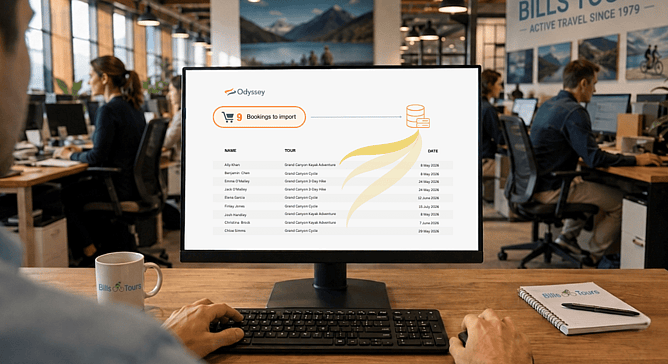
What actually happens after a customer books?
Most operators could probably draw this journey map from memory. A booking comes in. Someone checks the payment, someone transfers the guest details into the operational system, someone updates the departure manifest. and sends the confirmation email. Then someone notifies the relevant suppliers and also checks the rooming list. And you guessed it…someone has to update the guides too.
Not only is this a high volume of work if you're using inefficient systems like spreadsheets. But each of those steps is a hand-off. And every hand-off is a chance for something to go missing or come out wrong.
A guest dietary requirement that didn't make it to the restaurant. A bike size that was updated in the booking system but not in the supplier spreadsheet. A guide working off a manifest that was accurate three days ago but isn't today. These might not seem catastrophic on their own. But they will accumulate over a season, and they erode the quality of the experience your guests actually have. But your reputation is the main thing that gets impacted as word of mouth can travel fast, and when that happens it’s a slippery slope to get back up.
The hidden cost here is not just the occasional error. It's the staff time involved. In a well-run operation, a meaningful portion of every working week goes into moving information between systems that should already be connected. That's time your team is spending on data entry rather than on the work that actually improves the trip. And time on fixing things is a cost for the business, and frankly a headache for your team.
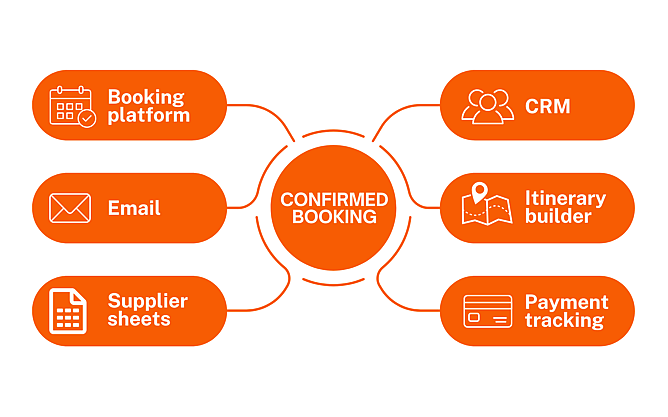
Why do so many operators still run on disconnected systems?
Because each piece of the puzzle was added at a different time, for a different reason.
The booking platform came first, because you needed to take reservations. Then a spreadsheet for suppliers, because the booking platform didn't handle that. Then a separate email system, because the spreadsheet couldn't send communications. Then another spreadsheet for rostering, because the email system didn't track staff. Each addition made sense at the time. The result is a patchwork of tools that your team has to hold together manually.
And now you might be thinking an Ai ‘widget tool’ for workflow 23 might be the best thing… it’s possibly going to be the same trap so just be careful you don’t end up with an Ai stack that doesn’t connect.
The problem isn't that any one of these tools are bad. It's that none of them were designed to talk to each other. So the information that lives in your booking platform doesn't automatically appear in your supplier communication. The confirmation that went out to the guest doesn't automatically update the guide brief. Someone has to make those connections, every time, for every booking.
Curious what this admin overhead is actually costing your business? The Ody Shop Booking Cost Calculator lets you run your own numbers, including the operational overhead, against a connected flat-rate model. https://www.myodyssey.app/calculator/
What does it look like when sales and operations are actually connected?
The difference is most visible in the first few hours after a booking comes in.
In a connected system, the booking data flows directly into the operational workflow. The scheduled departure updates for Groups, or it creates a new one for FIT. The customer gets emails and this starts the customer communications journey until after the tour. The supplier communication is generated from the same source of truth to get the accommodation and activities booked. The guide brief document reflects the current state of the trip, not a snapshot from two days ago. The payment record sits alongside the booking record, not in a separate spreadsheet someone has to remember to check.
Your team still controls what gets sent and when, or automations can be set up. The key difference is the work of pulling information together, reformatting it for each recipient, and re-entering it in the next system down the chain, that part disappears. What your team gets back is time. Time for the things that actually need human judgement: handling a last-minute change, building a relationship with a supplier, or designing the next trip. Time is the biggest cost of your business, lack of time, or unintentional time wasting, is also a big stress for your team. They don’t come to work to waste the business or customer time.
And when something changes close to departure, which it always does, a connected system lets you update the information once and have it flow through to everyone who needs it. The hotel gets the revised rooming list. The guide gets the updated brief. The transport company gets the current manifest. One change, one place and everyone’s current.

Why does the booking platform often not solve this?
This is the part of the conversation that most booking platform sales pitches skip over.
A Res Tech booking platform is designed to take the reservation and process the payment. That's what it was built for, and most of them do it pretty well. But the operational work that follows the booking, the customer communications, the logistics, the supplier coordination, the guide management, the departure planning, that's a different problem. And most booking platforms don't touch it.
So you end up with a well-optimised front end and a manual back end. The booking comes in cleanly. Then someone has to start transferring information into the systems that actually run the trip. That manual hand-off is where time goes, where errors creep in, and where the quality of the operational delivery can fall short of what the guest was sold.
This is why the cost of a booking platform is never just the platform fee. It's the platform fee, plus the merchant fee, plus the staff hours spent doing the work the platform hands off to your team the moment the booking is confirmed.
What does a better setup look like for a Multi-day Operator?
The operators who have moved past this describe it the same way. They want a system where the booking data doesn't have to be re-entered anywhere. Where the supplier communication comes from the same source as the guest communication. Where the guide brief is generated from live trip data, not rebuilt from a document every time. Where a change in one place flows through everywhere it needs to.
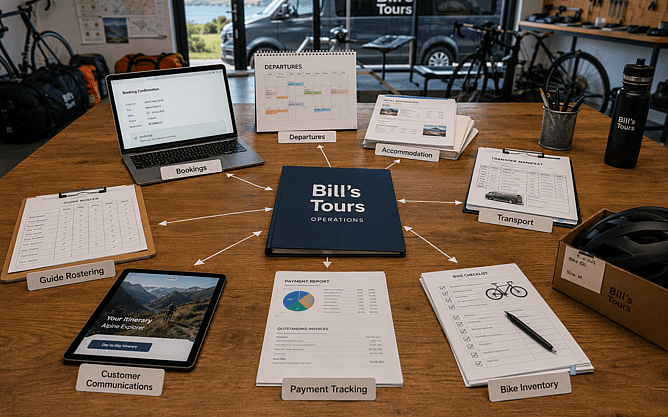
That's what a connected operational platform does. Not just bookings and bum-on-seat manifests, but the full picture: departures, suppliers, logistics, guide rostering, customer communications, payment tracking, and bike inventory for operators who need it.
Odyssey is built for exactly this. When a booking comes in through the Ody Shop booking platform, it flows directly into the operational system and the departure is updated. Simple and connected, and you have just saved your business time and costs. It's the difference between a business that can grow without hiring proportionally more staff to manage the admin, and one that can't.
See what your current booking technology is actually costing you, and how a connected, flat-rate model compares. https://www.myodyssey.app/calculator/ Ready to see Odyssey running in your own operation? Get in touch and we'll walk you through it. https://www.myodyssey.app/book-a-demo/
About the Author
Al Check is Co-Founder of Odyssey, the operating system for multi-day tour operators. He leads sales, marketing, business development, AI strategy, and channel partnerships, helping tourism businesses simplify operational complexity and build scalable, AI-ready systems.
With more than two decades of experience in adventure tourism, Al has worked across guiding, customer service, reservations, operations, and senior leadership. His hands-on experience includes helping establish a new depot operation for Cycle Journeys and contributing to the leadership of one of New Zealand’s largest self-guided cycling businesses.
Al regularly writes and speaks on tourism operations, business improvement and the role of AI in helping operators turn trusted data into practical business intelligence. He does this through industry communities, including the Adventure Travel Trade Association, Tourpreneur, and Cycle Summit.