
When a new booking lands in your inbox, the instinct is to focus on the revenue. Someone has committed. Money is coming in. That's a good day.
But how much of that booking are you actually keeping?
For most Multi-day Tour Operators, the honest answer is: less than they think. The visible number on the booking is not the number that hits the bank. Between platform fees, transaction costs, payment gateway charges, and in some cases OTA commissions on top, the economics of taking an online booking are more complex than they appear on the surface.
And most operators have never sat down and done the full maths. Or feel like they are in control of this, or can change anything. We’re going to challenge some of this in this series on Booking Technology.
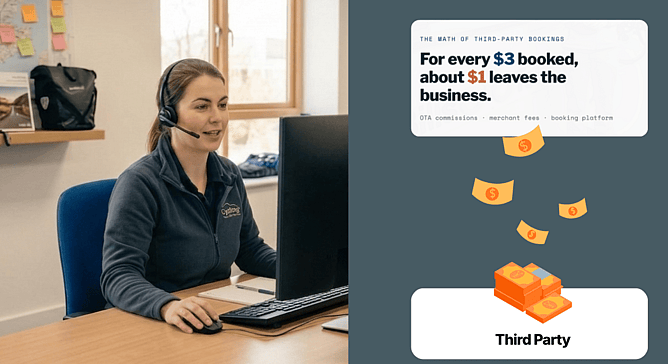
What does it actually cost to take an online booking?
The cost of processing a booking is not a single number. It can actually be a stack of different costs that ‘clip your ticket’.
Most booking platforms charge in one of two ways: a percentage of the booking value taken per transaction (most do this), or a flat monthly subscription regardless of how many bookings you take (few do this). Some charge both. On top of that, your payment gateway (merchant fees), whether that's Stripe, Windcave, PayPal, or something else, takes its own cut of every transaction. That percentage is separate from whatever your booking platform charges.
For a $2,000 multi-day cycling booking, the sums might look something like this. A 3% platform fee is $60. A 1.7% merchant fee is $51. That's $111 gone before your team has done a single hour of operational work on that trip. Run 500 of those bookings through a season and you're looking at over $55,500 in technology costs alone, before you account for the time your team spends managing the admin those systems create.
That's not a criticism of any specific platform. It's just what the numbers look like when you add them up.
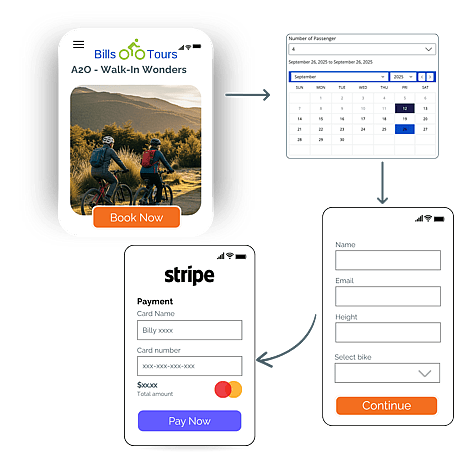
Use the Ody Shop booking cost calculator to run the numbers on your own business. Enter your booking volume, average booking value, and current platform and merchant fees to see what your technology is actually costing you each season, and how that compares to a flat-rate model. https://www.myodyssey.app/calculator/
Why does the pricing model matter more as you grow?
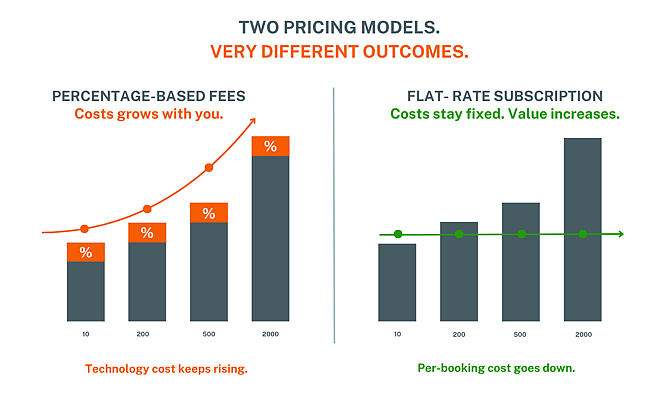
A percentage-based platform fee feels manageable when you're doing 10 bookings a season. It grows with your revenue, which seems fair. And getting a commitment from the customer and/or full payment is essential, and ideally you want to have an online self-serve option available. The problem is the costs keep growing with your revenue, every season, without limit.
Operators who have built their businesses from 200-300 bookings a year to 500-2000 have sometimes found that their technology costs have grown faster than their margins. The platform that made sense when they were small has become a significant overhead by the time they're mid-sized. And because the fee is baked into every transaction, it doesn't feel like a cost in the same way a monthly invoice does. It just quietly disappears from each booking.
A flat-rate subscription, like Odyssey provides, works differently. You pay a fixed amount per month regardless of how many bookings you take or what they're worth. In a low-volume season, that might feel like a lot. But as volume grows, the per-booking cost of that subscription drops. The technology gets relatively cheaper the more you use it, which is the opposite of how percentage-based pricing works.
The question every operator should ask is: at my current booking volume and average booking value, which model costs me less? And at the volume I want to reach in three years, which model would I prefer to be on?
What questions should you ask when evaluating booking technology?
Most Operators evaluate booking platforms on features: what can it do, how does it look, how hard is it to learn. Those are fair questions. But the cost structure deserves the same level of scrutiny.
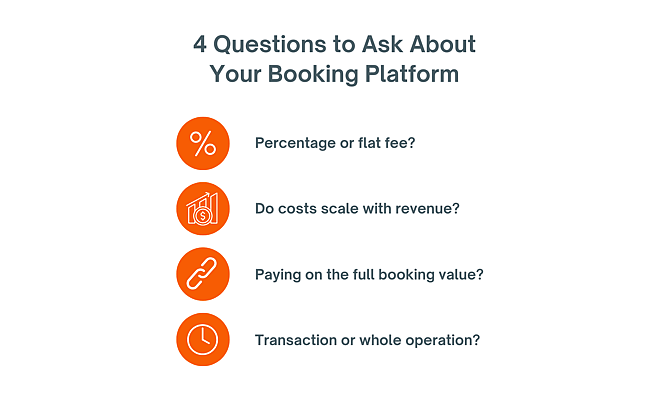
A few questions worth asking:
Is the platform fee a percentage of booking value, a flat subscription, or a combination of both?
Are there additional fees charged to the customer at checkout on top of what I pay? And if so, does that affect my conversion rate?
What does my payment gateway charge per transaction, and is that included in what the platform quotes me or separate?
If my revenue doubles next year, does my technology cost double too?
Do I get charged the full tour amount even though I only take a deposit through the platform, this one’s a sneaky hidden cost you should be aware of
What does the platform actually connect into? Bookings, operations, communications, supplier management, or just the transaction itself?
That last question matters more than most operators realise. A booking platform that handles the transaction but leaves your team to manage everything else through spreadsheets and email is not solving the full problem. It's solving the front end of it and leaving the expensive, time-consuming part untouched. Where the real, hard work of coordination and complexity happens many Operators have had to revert to spreadsheets, often due to the high cost of the front end booking platform they use.
The cost of disconnection
There is another cost that doesn't show up in any platform fee: the cost of running disconnected systems.
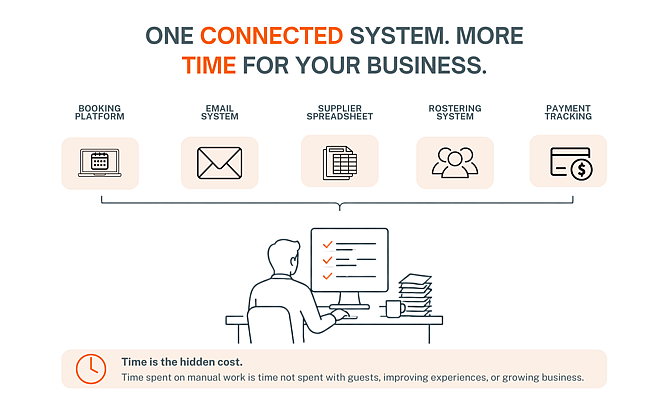
Most operators have a booking platform, a separate email system, a spreadsheet for supplier management, another for rostering, and something else for tracking payments. Every piece of information that moves between those systems has to be re-entered by hand, and every re-entry is a chance for something to go wrong.
A booking comes in and someone has to transfer the guest details into the operational system. Someone has to update the supplier spreadsheet and the next person has to send the confirmation email, check the payment, and make sure the guide brief reflects the current group size. Each of those steps takes time, and across a full season of bookings, that time adds up to a significant overhead your business is paying in staff hours rather than platform fees.
The true cost of your booking technology is not just what you pay for the platform. It's the sum of the platform fee, the payment gateway, and the operational labour your current system requires. That's the number worth calculating.
What does a better model look like?
The operators who have worked through this calculation tend to land in the same place. They want a system that charges them a predictable, flat rate, connects directly into their operational workflows, and reduces the amount of manual work their team has to do every season.
That's the argument for a connected, subscription-based platform over a transaction-fee model. Not just because it can cost less at scale, but because the efficiency gain compounds over time. The more bookings you take through a system that connects sales into operations, the less per-booking administration your team carries.
Ody Shop is Odyssey's online sales platform, built for Multi-day Tour Operators who want to take bookings online without the ongoing percentage fees, and without the disconnect between the booking and the rest of their operation. It runs on a flat monthly subscription, which means the cost is predictable regardless of your season volume. And it connects directly into Odyssey, so the booking data flows straight into your operational workflows without anyone having to re-enter it. This is especially important for the complexity of Multi-day Tours.
Use the Ody Shop booking cost calculator to run the numbers on your own business. Enter your booking volume, average booking value, and current platform and merchant fees to see what your technology is actually costing you each season, and how that compares to a flat-rate model. https://www.myodyssey.app/calculator/
About the Author
Al Check is Co-Founder of Odyssey, the operating system for multi-day tour operators. He leads sales, marketing, business development, AI strategy, and channel partnerships, helping tourism businesses simplify operational complexity and build scalable, AI-ready systems.
With more than two decades of experience in adventure tourism, Al has worked across guiding, customer service, reservations, operations, and senior leadership. His hands-on experience includes helping establish a new depot operation for Cycle Journeys and contributing to the leadership of one of New Zealand’s largest self-guided cycling businesses.
Al regularly writes and speaks on tourism operations, business improvement and the role of AI in helping operators turn trusted data into practical business intelligence. He does this through industry communities, including the Adventure Travel Trade Association, Tourpreneur, and Cycle Summit.