
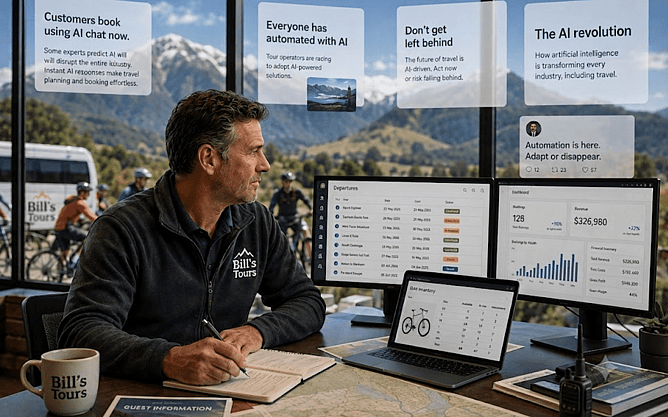
Open LinkedIn or read travel news, and it feels like every tour company automated their business with AI overnight. This creates a false pressure that makes you feel like you are falling behind. However, the real facts tell a much different story.

Am I falling behind other tour operators with AI adoption?
Across the adventure travel industry, the signal is the same: operators aren't rushing to automate everything. ATTA's own coverage of the sector points to a shift toward profitability and operational efficiency, not chasing new technology for its own sake, but moving slow, with purpose. That matches what's happening more broadly across industries too. Most businesses are still working out what AI actually means for how they operate day to day, not racing to overhaul everything overnight. You're in that same boat.
This shift is not about chasing a shiny tech trend. It is about making your daily work easier and building a stronger business.
How should a tour operator go about AI adoption?
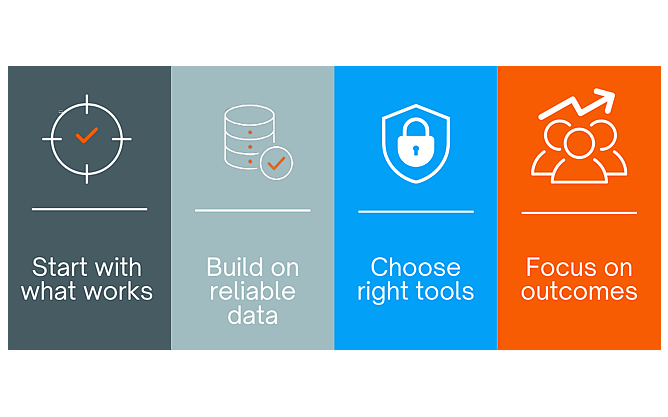
To move forward, you cannot start only with AI. You must start with your business truths. The big AI advantage will not go to the company with the most tools. It will go to the company with the clearest organisation. Maybe your safety rules, guide notes, and supplier details are scattered across email inboxes and spreadsheets. If that information is messy, AI cannot read it or help you. Your first step is not buying AI. Your first step is organising your business data so AI can actually understand it.
How can I protect my proprietary itineraries and product data?
To use AI safely, you must know where your information goes when you type it into a computer.
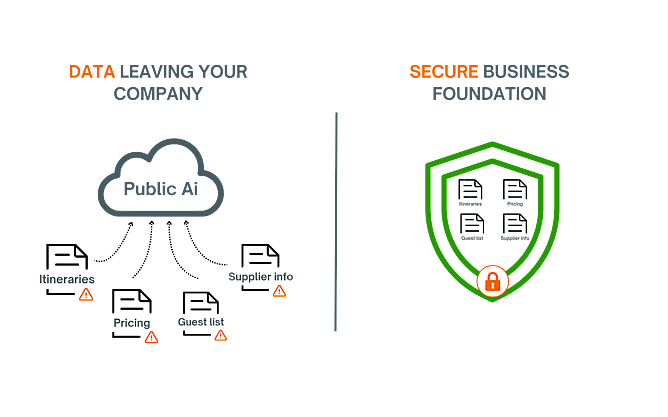
Think about your data. You work hard to create unique itineraries, guest lists, and pricing strategies. If you type these into public, open AI tools, you are giving away your brand secrets, which other people can see. Public tools pose a big risk to your private business ideas unless you apply specific security controls.
Here is the difference between the two main types of AI:
Open vs. Closed Models: Who can see your data and who controls it matters more than whether a model is labelled open or closed. Open-weight models can run on your own systems, so nothing leaves your business for those tasks. Closed, vendor-hosted models process your data on someone else's servers, which is fine as long as you have a clear agreement about how that data is stored and used. Ask your technology partner exactly where your data goes and who can access it before you commit to any AI tool.
Keeping Data Local: Not every task needs to leave your building. Routine jobs, like drafting a standard reply or checking availability, can run on local or open-source models that never send your information anywhere. More complex work can go to frontier models like Claude or GPT, under an agreement that your data isn't stored or used for training. The right setup routes each task to the right model, so sensitive pricing and itinerary data only goes where it needs to..
Setting Human Guardrails: Travel businesses need total control to manage risks. Good AI systems let you turn controls on or off. You decide exactly when the AI can make choices and when a human teammate must step in.
When is it appropriate to use an open data model in my tour business?
Open Models certainly have their place, and the major driver would be the cost of AI processing power. With the appropriate technology partner, you can use cheaper, local/open-source LLMs for routine day-to-day tasks that don’t use any confidential data (or aggregate it and conceal personal information). Reserve frontier/closed models like Claude, Gemini or GPT for complex work. This split aims to keep AI affordable for tour operators. Your technology partner would ensure that the correct data would be available to each model type.
What AI features will a multi-day tour operation need?
Here is how a secure AI system will practically change a busy tour office:
1. The Digital Brain (Knowledge Centre)
The Concept: Think of this as your digital instruction manual. You teach the AI exactly how your business runs. You feed it your safety rules, policies, guide schedules, and past trip notes. It learns what went wrong on past trips and how your team fixed it.
The Control: The system works strictly under your rules. It learns your unique business style without showing it to the outside world.
2. Secure, Structured Data
The Concept: Your data must stay organised, in a single database and be securely locked down to protect your profits.
The Privacy: Strong security rules keep your local supplier relationships and private price margins safe. Your special hiking routes stay completely private.
3. Fast Answers Around the Clock
The Concept: Modern travellers want fast answers. They will not wait for you to wake up in a different time zone.
The Tools: An integrated AI email tool reads and writes messages automatically. It handles the simple, routine enquiries and reserves the tough questions for your team to answer. The uses everything you taught your private digital brain to give exact trip facts. It uses your company's friendly voice, so you never lose the human touch.
4. Fast Itinerary Building
The Concept: The AI system can adapt base itineraries to include different tour variations such as accommodation upgrades, side trips, activities, departure dates and independent travel.
The Interface: A simple drag-and-drop screen shows your trips in a modular style. The itinerary can be easily adjusted, and new suppliers added to the trip plan. Each personalised itinerary is output in different visual views that meet your suppliers’ requirements.
5. A Dashboard that Highlights the Exceptions
The Concept: Business owners should not waste time handling routine, repetitive tasks. The exceptions that the AI couldn’t resolve that require staff intervention are highlighted on a priority dashboard.
The Execution: A clean dashboard clears out the noise. The system handles standard tasks automatically. Your human team only steps in when a real issue pops up. This leaves you free to focus on your guests.
6. Connected Team Workflows
The Concept: This tool connects the tour operator AI system to the supporting cast of drivers, guides, suppliers and agents.
The Execution: Automatic systems turn tour updates into instant texts or emails. If a trip schedule changes, the system sends custom alerts to customers, field guides, accommodation suppliers and booking agents following your workflow guidance.
7. Learning from the Past
The Concept: Stop guessing about the future. Start using real facts to plan ahead.
The Execution: The system reads your data as it happens to spot trends. This helps you make smart decisions about gear availability, prices, and changing traveller habits before those shifts hurt your wallet.
How do I balance implementing AI with maintaining human connection in adventure travel?
AI will never replace the magic of a guided trek. It cannot replace a local guide or the human connection of a great tour. It is simply here to clear out the annoying paperwork and messy spreadsheets that slow you down.
Building an AI plan today is not about changing your whole business by tomorrow morning. It is about organising your data right now. That way, you can use technology to win in the long run.
Here is a Positive First Step
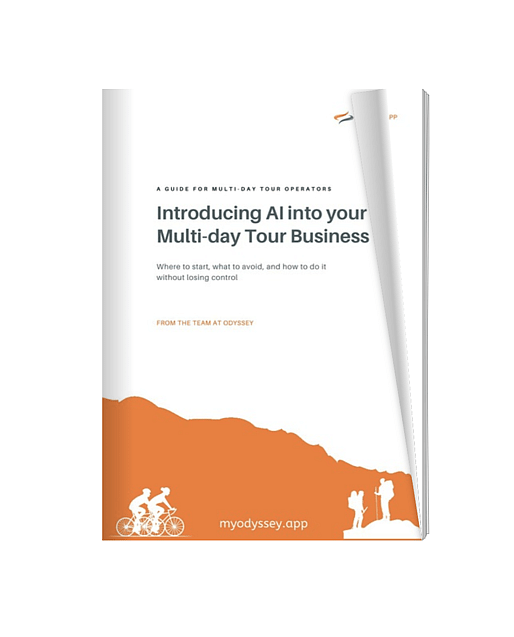
Download our White Paper: Introducing AI to your multi-day tour business: where to start, what to avoid, and how to do it without losing control.
This guide shows you the practical dos and don'ts of modern travel tech. You will learn how to evaluate AI risks, make some key data decisions and start building an AI strategy for your tour operation. It also includes a link to a simple Team AI Check-In to help you understand the current status of AI usage in your business.
About the Author
Al Check is Co-Founder of Odyssey, the operating system for multi-day tour operators. He leads sales, marketing, business development, AI strategy, and channel partnerships, helping tourism businesses simplify operational complexity and build scalable, AI-ready systems.
With more than two decades of experience in adventure tourism, Al has worked across guiding, customer service, reservations, operations, and senior leadership. His hands-on experience includes helping establish a new depot operation for Cycle Journeys and contributing to the leadership of one of New Zealand’s largest self-guided cycling businesses.
Al regularly writes and speaks on tourism operations, business improvement and the role of AI in helping operators turn trusted data into practical business intelligence. He does this through industry communities, including the Adventure Travel Trade Association, Tourpreneur, and Cycle Summit.