
Build versus buy isn't a new question in software. What's changed is AI, which makes it look like anyone can code their own solution now. Here's somethings to consider if you're weighing up the two paths for your business.
If AI is making software development easier, why can't I do it myself?
AI makes do-it-yourself coding look a lot more possible than it used to. For a handful of tour operators, it genuinely could be. For most, trying to build custom software turns into a drain on time, money, and energy that outlasts the initial excitement.
Multi-day adventure travel is a different scale of problem to a simple day tour: hotel availability, vehicle scheduling, guide rosters, fixed and flexible departure dates, all connected. Some AI models cost next to nothing to run, others add up fast, so it pays to know the difference. But the real expense isn't the model, it's teaching it how your business actually operates. Building a reliable travel assistant from scratch means writing a mountain of custom code to handle complex itineraries and workflows without breaking, and if you end up stitching together different AI tools for different jobs, you've just created a new connection problem on top of the old one. That's an ongoing maintenance job, not a one-off project, and it pulls you away from what you do best.
We hear from operators early in their AI journey who don't even have a clear picture of which AI tools their own team is already using day to day. Building a system for the whole business is a big leap from there.
Before you think about building your own AI system, it’s worth understanding where AI can actually fit into your tour operation. See our guide to AI for the Tour Operator for a practical starting point.
Should a tour operator buy or build an AI-enabled system?
For most tour operators, buying an AI-enabled system from a supplier who actually knows the travel industry is the more practical path than building your own. AI has made it faster to knock together a working prototype, but a prototype isn't the same thing as a system you can rely on every season, especially with the complexity and connections a multi-day tour needs.
An established platform gets you dynamic itinerary building and pricing, ready-made guest and supplier communications, and smart resource allocation from day one. Building your own only really pays off if you're a large-scale operator with genuinely unique algorithms or data needs nobody else can meet. For everyone else, buying keeps your attention where it belongs: on delivering a great trip.
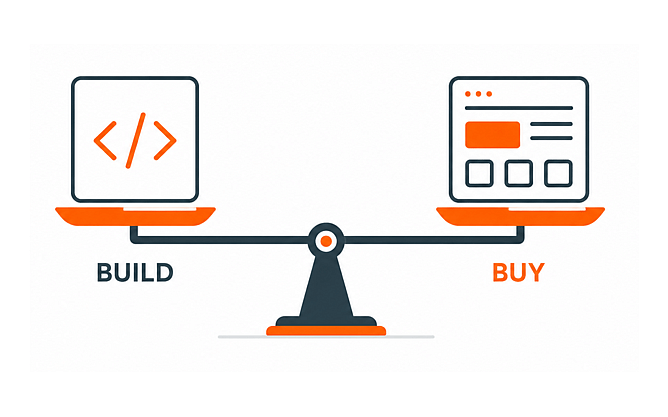
What questions should tour operators ask before building custom AI?
Time and resources for building custom software add up quickly. So it comes down to one simple question: are you a travel company, or a tech company? Working through a few key questions upfront stops you sinking money into a project that probably won't deliver what you're hoping for.
Here are the questions worth asking yourself:
How much time and money do you actually have? Every hour spent managing code is an hour not spent on the guest experience, building your team, and partnership channels to drive a better product and profitable business.
How do you know your data is actually secure? Custom-built tools often skip the level of security a dedicated platform builds in from the start, which puts customer records and your supplier rates at risk.
Who fixes it when your season begins? If a connection breaks during peak bookings, you need someone available right then, not whenever your developer's free.
How will you keep up as AI keeps changing? The models underneath these tools move fast, and keeping custom code working with them is an ongoing job, not a one-off.
And this is not just a travel issue. A 2026 report on build-versus-buy decisions from CFO Shortlist, aimed at finance teams weighing up the same question, found much the same pattern: "The most expensive elements of internal systems rarely appear in the initial business case," with the real cost showing up later as documentation gaps, ageing integrations, and one person becoming the only one who understands how it all works. In a small tour business, that one person is usually the owner. The report notes these problems tend to surface 12 to 24 months after launch, by which point the system is too embedded to easily replace.

Safeguard the things that form your competitive advantage
Your competitive advantage is the operational intelligence you've built up over years, the stuff that makes your trips different from a mass-market itinerary. That's your guide assignments, your routes, your pricing, your supplier relationships, and just as much, the practical detail: which bikes and gear go where, who's driving which vehicle, how luggage moves between stops, what happens when a supplier falls through two days into a trip.
Feed a generic AI tool your business without that structure behind it, and it'll produce a generic itinerary, one that can miss real safety and service requirements because it never had the full picture. Odyssey is built to hold that picture. It's where your operational history, your customer preferences, and your routing logic live in one connected, trusted system, not scattered across someone's inbox.
How does an in-house build compare to an industry platform?
It comes down to speed versus control. Building your own gives you total ownership over every decision. Buying a dedicated platform works right away, and someone else handles the updates.
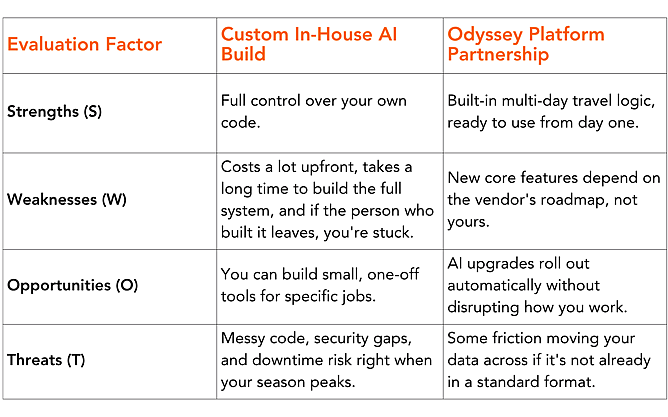
Our advice, work with a trusted software partner
AI makes building your own look easy. In practice, it still takes more time, money, and ongoing upkeep than most tour operators have available.
Building AI isn't expensive because of the model. It's expensive because the model doesn't know your business. We do.
Partnering with an established system like Odyssey gets you working AI features now, with a platform that’s already building toward a fully AI-native future. It lets you stay focused on what actually matters: running great tours.
Looking to kick start AI with your team…
Download our White Paper: Introducing AI to your multi-day tour business: where to start, what to avoid, and how to do it without losing control.
This guide shows you the practical dos and don'ts of modern travel tech. You will learn how to evaluate AI risks, make some key data decisions and start building an AI strategy for your tour operation. It also includes a link to a simple Team AI Check-In to help you understand the current status of AI usage in your business.
About the Author
Al Check is Co-Founder of Odyssey, the operating system for multi-day tour operators. He leads sales, marketing, business development, AI strategy, and channel partnerships, helping tourism businesses simplify operational complexity and build scalable, AI-ready systems.
With more than two decades of experience in adventure tourism, Al has worked across guiding, customer service, reservations, operations, and senior leadership. His hands-on experience includes helping establish a new depot operation for Cycle Journeys and contributing to the leadership of one of New Zealand’s largest self-guided cycling businesses.
Al regularly writes and speaks on tourism operations, business improvement and the role of AI in helping operators turn trusted data into practical business intelligence. He does this through industry communities, including the Adventure Travel Trade Association, Tourpreneur, and Cycle Summit.