
Over the last two weeks I've shown you what an ordinary working day looks like in Odyssey 2.0, and what happens to the admin that eats the rest of your week. This week I want to talk about the question I get asked the most at events like ATWS and Cycle Summit. You know you need to move into AI, but how on earth do you do that when you're in the middle of running tours?
If you've been running tours for a while, your business probably runs on a mix of things. Some of you are on spreadsheets, some on an older system that's done the job for years, and some of you have built your own. Whatever it is, it works, and your team knows how to use it. So when someone says it's time to move, the first thought is usually about timing. Who's going to do it, when, and what happens to the tours already running? In season there's no spare time, and nobody wants to risk the bookings coming in just to try something new.
Both feelings are fair. You know AI is coming to your business, and you know a rushed change can cost you more than it saves. That's why we don't rush it.
What kind of change do you actually need?
Before you start, it helps to be clear about what you're trying to change, because people mean two quite different things when they say they want to move to AI.
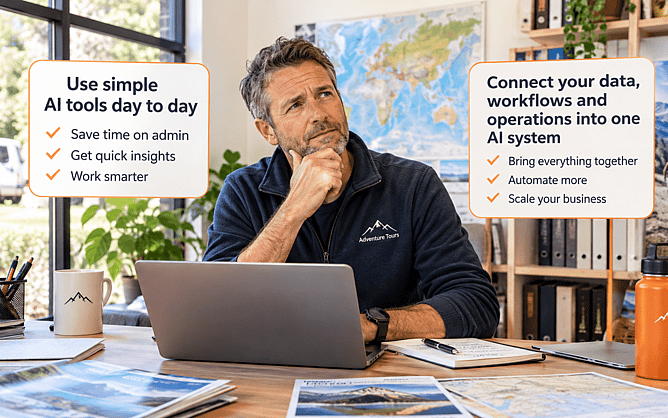
One is adding an AI tool or two that your local team can use day to day, like tidying up an email or an itinerary. That's a good place to start, and most teams can run with it on their own. The other is connecting all of your data and your workflows into one AI system, so it knows your tours, your suppliers, your policies and how you do things, and can help you run the business. They're two different projects and they need different approaches. This blog is about the second one.
Whichever you choose, get your team on board first. Find a champion, someone in your business who's keen to lead this and who the rest of the team trust. Then find out where your people are at with AI, because some of them are probably already using it. Our guide to introducing AI into your tour business has an AI team survey you can use to do just that: Introducing AI into your multi-day tour business
If you're not sure which you need, start by looking at where you are now. How does your team work, what do you need from a system, and what state is your data in? Is it in one place, or scattered across spreadsheets and inboxes? A good way to get a preview of where you are, and where the opportunities might be, is a discovery call with a technology company. We offer these for free, at no obligation.
How do you tackle changing systems when you're in season?
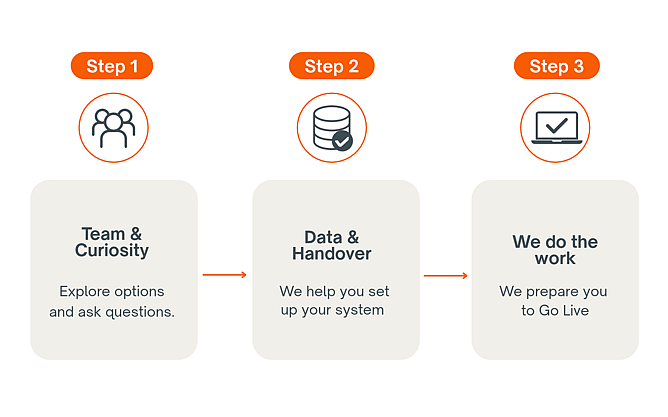
Let's walk this through. The mistake most of us make is trying to squeeze a system change in between tours, which is why it keeps getting put off. A better way to think about it is as a three step project, spread over three quarters, that finishes before your next season starts. Work backwards from the day you want your team using it.
It's critical to bring your team on board, and you've started to socialise it and get their input. Bring them into the conversation early. This is not a "Hey, we've decided, and next week we're turning this on." This is a "Hey, here's where we're at, here's where we're thinking of going, here are our options, and we want to show you what they look like."
Step 1, first quarter: get your team on board, and get curious. Once you've got your champion and know where your team is at, it's time to be curious. Do a discovery call, get a demo, and ask who outside your company can help with your goals. You don't know what you don't know, and a good conversation will show you what's possible, and what to avoid, before you've spent anything.
Bring your team along to the demo, whether it's your heads of department, your longest-serving staff member who has all the knowledge, or a person who maybe isn't comfortable with change. It's a good opportunity to bring them on board early, ask questions and be involved.
Now you need to make a decision with your team, with your stakeholders, and get ready to move into the next phase of implementation.
Step 2, second quarter: gather your data and hand it across. Depending on what solution you've decided on, you will be guided by that provider as to what information you need to bring together. That might be your tour information, supplier details, policies, procedures and SOPs.
How much gets done for you depends on who you choose. Some technology companies will set up your account and leave you to it, some will give you a template to fill in, and others, like us, will give you a white glove service and help you set up your system.
AI has changed this step. A technology company like us can now use AI to move your data and information into the new system and get you set up. Historically that's been a cumbersome and costly process for both the operator and the tech company, but it's different today. If a provider charges you an onboarding cost, you've got every right to ask how that onboarding is done.
Keep your current system running while this happens, so nothing is put at risk.
Step 3, third quarter: show and tell. Now your technology provider should be giving you information and progress updates, and even showing you your data and information in the system live, so you have confidence at this stage.
It's imperative that you go through a checking process now, to make sure the data is accurate and meets your expectations.
If your team has some free time, they can go into the system and start getting familiar with how it works. Seeing themselves and their own data inside it makes a big difference.
Then bring your team together and walk through it using real world examples and your own workflows. Let them try it, fix whatever doesn't feel right, and agree who does what. By the end of the quarter it should be ready for your team to use at the start of the fourth.
Do you have to stop running tours while this happens? No, and you shouldn't. The whole point of spreading it over three quarters is that your season carries on as normal. The only time it needs from your team is where it counts, like showing how things are done and checking the result. By the time your next season starts you're not learning a new system in the middle of a busy week, it's already set up the way you work.
Is there a faster way? Sometimes, yes. A good technology company can bring in a lot of your information in bulk, like tour information, website content and PDFs, so the sooner you've collected it, the quicker everything else goes.
What if you've built your own system? A lot of operators have, and that effort isn't wasted. What's in it, your tours, your policies and the way you do things, is the most valuable thing you take with you. Early on, make sure you can actually get your data out of your legacy or in-house built system. Then you've got a clearer picture of what the transfer is going to look like.
What should you end up with?
In the fourth quarter, when the season ends, your team has the mental space and time to get more familiar with it. Then your next season's bookings start coming in, and from that point you should be using your new platform and retiring your old system.
What you end up with is one connected system and one source of truth. Your team and vehicles on one roster, your bike fleet on one timeline, and your suppliers and guests all in the one place. That's what lets AI help properly, because it's looking at the same picture you are, instead of guessing from scattered spreadsheets and separate tools.
Want to talk it through?
Of course, this all sounds good in theory. Our main recommendation is to reach out to a tech provider who knows these onboarding processes and knows change management for your team. Don't feel like you have to solve this yourself. Companies like us, it's what we do. Day to day, it's what gets us out of bed in the morning: to help operators improve their business.
Be curious, start early, stay in the conversation, and build trust and knowledge. Reach out if you'd like a conversation, just to understand what's possible.
About the author
Al Check is Co-Founder of Odyssey, the operating system for multi-day tour operators. He leads sales, marketing, business development, AI strategy, and channel partnerships, helping tourism businesses simplify operational complexity and build scalable, AI-ready systems.
With more than two decades of experience in adventure tourism, Al has worked across guiding, customer service, reservations, operations, and senior leadership. His hands-on experience includes helping establish a new depot operation for Cycle Journeys and contributing to the leadership of one of New Zealand's largest self-guided cycling businesses.
Al regularly writes and speaks on tourism operations, business improvement and the role of AI in helping operators turn trusted data into practical business intelligence. He does this through industry communities, including the Adventure Travel Trade Association, Tourpreneur, and Cycle Summit.