
The problem we hear most often from operators today is disconnected systems. A multi-day business is complex, and your data, workflows and processes all depend on each other, so they need to connect. When they don’t, your team ends up joining the dots by hand.
We’re also hearing from a few operators who say “we’re building things ourselves.” We understand that the tools are good, they’re cheap to start with, and the first content writer, chatbot or email drafter can work.
But there’s a set of questions that don’t come up at the start, and they matter more than the build. What is your AI reading? Is it correct information? How does it connect to everything else it needs to run your business? Who looks after it? And what does that cost over the long term?
The reason we raise this is that we can see operators falling into the same trap of building unserviceable, high-cost, bespoke AI solutions that aren't sustainable for their business. These are widely spread throughout the travel industry today. But there's a much bigger cost, and that's the ongoing cost to connect to other systems, and the cost to evolve as technology does. We see this today that Operators on legacy 'in house' built systems end up stuck with an over invested and hard to modify system. Making exiting a much needed, but painful, experience.
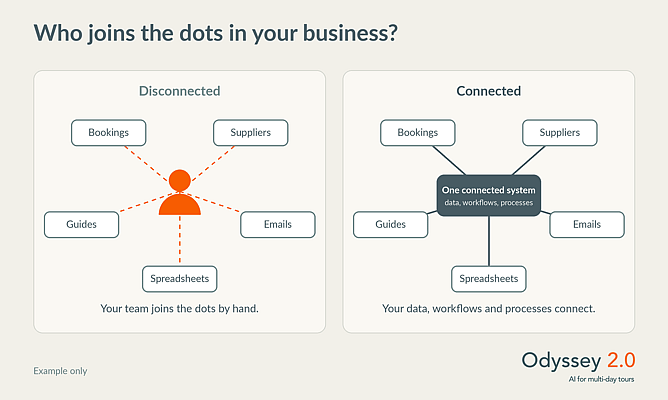
What is your AI actually reading?
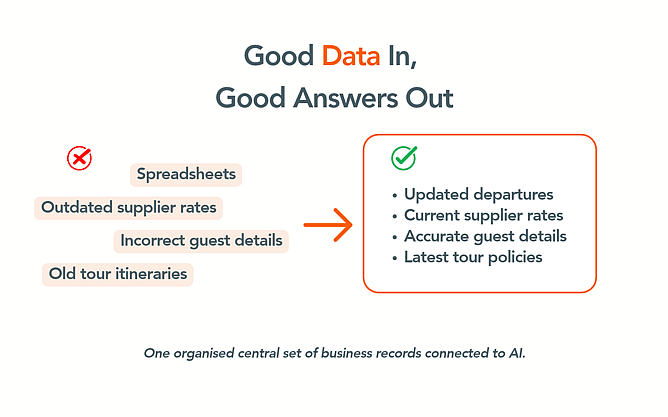
AI is only as good as what it has in front of it. So where does yours get your tours, your supplier rates, your policies and your guest details? Does it come from a folder of PDFs, or a spreadsheet someone updated three months ago, or a document you pasted in a year ago?
You should be asking three things about your data that you have stored. Is it accurate, is it reliable, and is it up to date? And then ask yourself who’s responsible for keeping it that way when a supplier changes, or you change your cancellation terms, or you introduce a new product.
Whatever you put in is what comes out. If the data going in is wrong, the answers coming out will be wrong too. This is an easy rule to remember about how AI works.
Our suggestion is to define where your AI gets its information before you build anything. Aim for your live records, the same departures, guests, suppliers and money your team is already working from, not a copy that someone has to remember to refresh. It still depends on those records being right, but then there’s one place to keep right, instead of five.
Where do most people hit the ceiling?
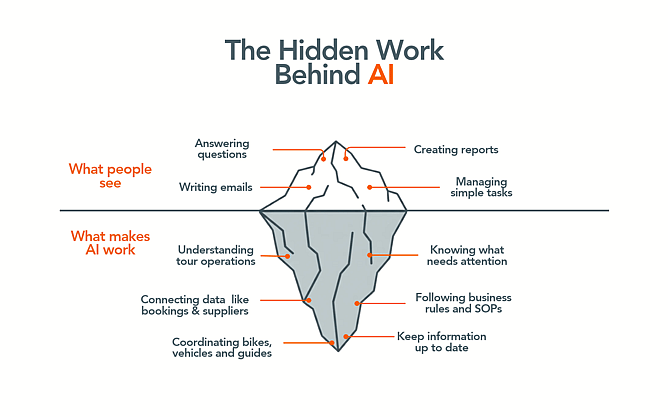
Building it isn’t where it gets hard, because getting an AI to answer a question is relatively easy. The ceiling comes when you ask it to help run a multi-day operation.
From our experience building Odyssey 2.0, it’s the connected detail that matters most. A multi-day tour isn’t just a booking. It’s bikes, vehicles, guides, luggage moving from one place to the next, suppliers who have to confirm, and guests who need to hear the right thing at the right time. For an AI to be useful, it has to learn how all of that fits together in your business, and then work within the guardrails you set for it.
Task management is a good example. Say you want a dashboard that tells you what needs you right now. That only works if something knows what “needs you” means in your operation. What counts as urgent, what can wait, and who deals with what. That takes a lot of rules, clearly written down as proper SOPs that an AI system can follow.
The thing is, most of those rules live in your head, or your team’s. You know when a late supplier is a problem and when it isn’t. You’ve never had to write it down, because you just do it. To build your own system, someone has to get that out of your heads and onto paper, test it, and keep it up to date as your business changes. It’s slow, detailed work, and in our view, this is what's going to get hard as operators use AI.
That’s the work we’ve done. After nearly 20 years in multi-day tourism, we’re adding those rules to the AI in Odyssey, so you’re not starting from a blank page. You still set the guardrails for your business. You just don’t have to write it all from scratch.
What do operators need from the system?
Operators shouldn’t just be thinking about bookings. You know the additional requirements across your business. And whether you are a large or small operator, you need similar things, the difference is the scale. If you build your own AI setup, you become the technology provider, so you need to be ready to deliver on that commitment. Here are a few things to consider beyond the basic use of AI.
Starting with the connections. Can your system send a message to your CRM, Slack or a spreadsheet when something changes? Do your automations run under a company account or under one person’s login?
Then your own data. Can you add your own custom fields, like a loyalty tier, without a developer? Can you get your old data in, and how much history comes across?
Then the AI. Where does it run, and who pays for it? Can you see who on your team is using it? And what is it allowed to do without a person approving it first?
Then control and privacy. Is there a record of who changed what? Does your team see everything or just what they are working on?
And the operation itself. Are your bikes managed as individual units? Can you hold supplier rates with seasons and blackout dates, and pay a supplier in another currency while still seeing your margin?
You don’t need all of it on day one. But each one is something someone has to build, connect and keep working.
What will it cost you?
We don’t have a study that tells you what a home-built AI setup costs a tour operator, and we’d be wary of anyone who quotes you a number. What we can do is show you where the cost sits.
Almost all of it is people’s time. The tools are the cheap part. After the build, someone has to keep your data right, maintain the integrations, APIs and webhooks that connect your systems, check what the AI is telling guests, and deal with it when the provider changes its model or pricing. Each new thing you build adds another connection to look after, so the work grows faster than the number of tools.
There’s a cost that’s easy to miss too. If anyone on your team puts details about your guests, suppliers or other third parties into an AI tool, privacy rules like GDPR come into it. A free or personal account usually doesn’t give you the protections you’d want. So everyone who uses AI for work may need a business AI licence, which is a cost for every person, every month. A short written policy on what can go in, and which accounts to use, is worth having.
Who looks after it?
You don’t need a department, but someone has to own each job: writing down how your business actually runs, keeping the data right, maintaining the connections, looking after security, and watching what the AI says and does. And someone, usually you, has to decide what the AI is allowed to do without a person checking.
If you bring in a contractor, ask who you’d ring when something breaks at seven in the morning with a group departing, and what happens if they leave.
Remember too that what the AI tells your guests is your promise, not the software’s. A wrong trip grade, pickup time or refund is your mistake, so keep a record and have a person who can step in.
None of this means you shouldn’t experiment. Build the chatbot. You’ll learn what you want. Just don’t build the whole business on it without knowing who’s going to look after it.
Want to talk it through?
If you’d like to talk it over, a discovery call is a good place to start. It’s free, with no obligation. We look at where you’re at with your technology, and we talk about AI with examples of how Odyssey 2.0 can apply it to your business.
About the author
Al Check is Co-Founder of Odyssey, the operating system for multi-day tour operators. He leads sales, marketing, business development, AI strategy, and channel partnerships, helping tourism businesses simplify operational complexity and build scalable, AI-ready systems.
With more than two decades of experience in adventure tourism, Al has worked across guiding, customer service, reservations, operations, and senior leadership. His hands-on experience includes helping establish a new depot operation for Cycle Journeys and contributing to the leadership of one of New Zealand's largest self-guided cycling businesses.
Al regularly writes and speaks on tourism operations, business improvement and the role of AI in helping operators turn trusted data into practical business intelligence. He does this through industry communities, including the Adventure Travel Trade Association, Tourpreneur, and Cycle Summit.